
Hi Friends, Acommon question I have been asked throughout the course of my 28+ year career in the mortgage industry is “Where are interest rates going?”
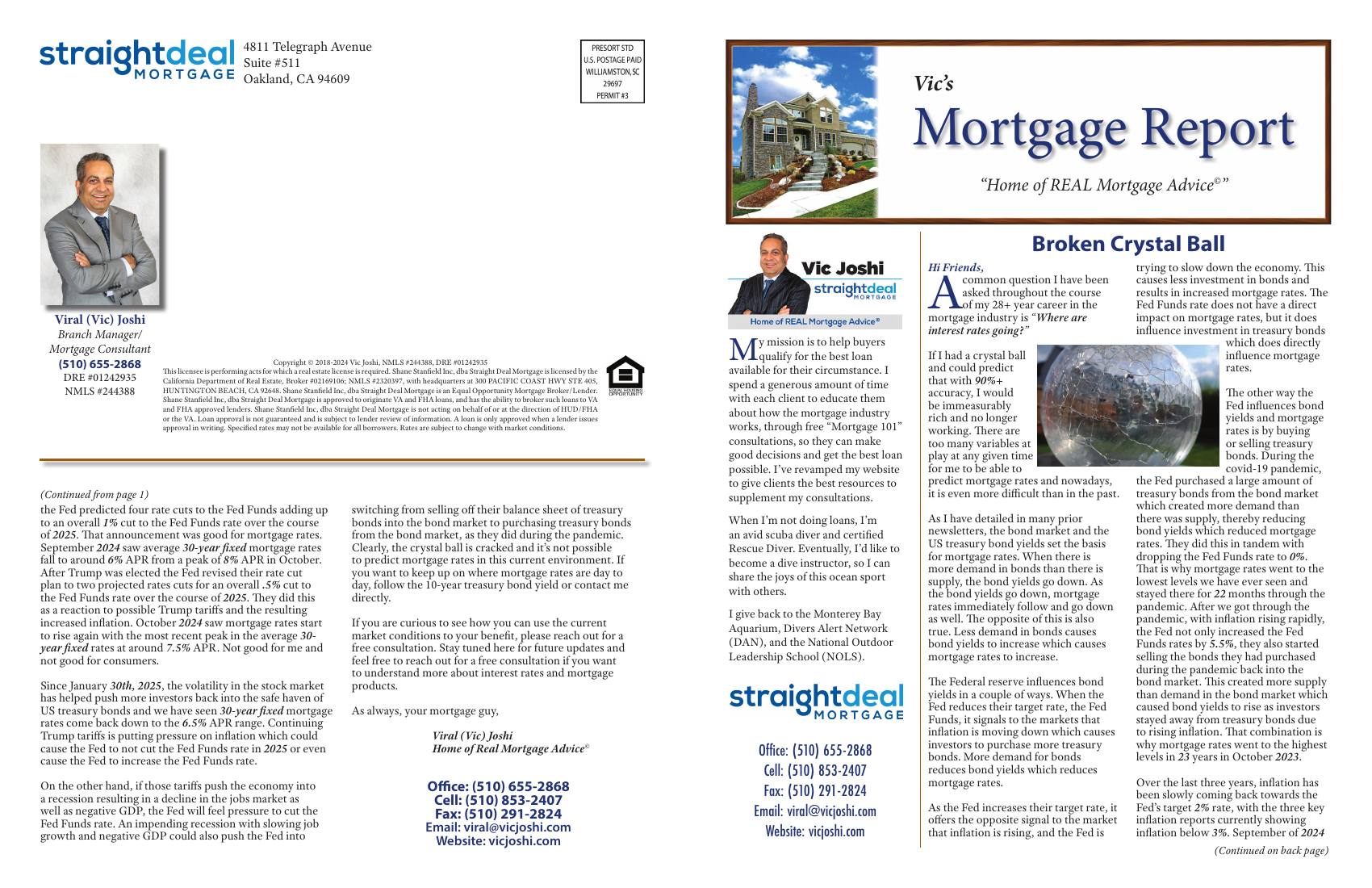
If I had a crystal ball and could predict that with 90%+ accuracy, I would be immeasurably rich and no longer working. There are too many variables at play at any given time for me to be able to predict mortgage rates and nowadays, it is even more difficult than in the past.
As I have detailed in many prior newsletters, the bond market and the US treasury bond yields set the basis for mortgage rates. When there is more demand in bonds than there is supply, the bond yields go down. As the bond yields go down, mortgage rates immediately follow and go down as well. The opposite of this is also true. Less demand in bonds causes bond yields to increase which causes mortgage rates to increase.
The Federal reserve influences bond yields in a couple of ways. When the Fed reduces their target rate, the Fed Funds, it signals to the markets that inflation is moving down which causes investors to purchase more treasury bonds. More demand for bonds reduces bond yields which reduces mortgage rates.
As the Fed increases their target rate, it offers the opposite signal to the market that inflation is rising, and the Fed is trying to slow down the economy. This causes less investment in bonds and results in increased mortgage rates. The Fed Funds rate does not have a direct impact on mortgage rates, but it does influence investment in treasury bonds which does directly influence mortgage rates.
The other way the Fed influences bond yields and mortgage rates is by buying or selling treasury bonds. During the covid-19 pandemic, the Fed purchased a large amount of treasury bonds from the bond market which created more demand than there was supply, thereby reducing bond yields which reduced mortgage rates. They did this in tandem with dropping the Fed Funds rate to 0%. That is why mortgage rates went to the lowest levels we have ever seen and stayed there for 22 months through the pandemic. After we got through the pandemic, with inflation rising rapidly, the Fed not only increased the Fed Funds rates by 5.5%, they also started selling the bonds they had purchased during the pandemic back into the bond market. This created more supply than demand in the bond market which caused bond yields to rise as investors stayed away from treasury bonds due to rising inflation. That combination is why mortgage rates went to the highest levels in 23 years in October 2023.
Over the last three years, inflation has been slowly coming back towards the Fed’s target 2% rate, with the three key inflation reports currently showing inflation below 3%. September of 2024
Since January 30th, 2025, the volatility in the stock market has helped push more investors back into the safe haven of US treasury bonds and we have seen 30-year fixed mortgage rates come back down to the 6.5% APR range. Continuing Trump tariffs is putting pressure on inflation which could cause the Fed to not cut the Fed Funds rate in or even
2025 cause the Fed to increase the Fed Funds rate.
switching from selling off their balance sheet of treasury bonds into the bond market to purchasing treasury bonds from the bond market, as they did during the pandemic. Clearly, the crystal ball is cracked and it’s not possible to predict mortgage rates in this current environment. If you want to keep up on where mortgage rates are day to day, follow the 10-year treasury bond yield or contact me directly.
If you are curious to see how you can use the current market conditions to your benefit, please reach out for a free consul tation. Stay tuned here for future updates and feel free to reach out for a free consultation if you want to understand more about interest rates and mortgage products.
On the other hand, if those tariffs push the economy into a recession resulting in a decline in the jobs market as well as negative GDP, the Fed will feel pressure to cut the Fed Funds rate. An impending recession with slowing job growth and negative GDP could also push the Fed into