
Hi Friends, Last month I closed by warning that the bond market’s temporary breather could end quickly; it has. Mortgage rates have resumed their climb as a triple-stack of hot inflation reports, surging oil prices, a fresh oneyear high in the 10year Treasury yield, and a sharp move higher in European bond yields have all turned against borrowers in the span of about four weeks.
The Federal Reserve’s preferred inflation gauge led the bad news. The March 2026 PCE report, released 4/30/2026, showed headline prices up 0.7% for the month and 3.5% year over year – the fastest pace since May 2023. Core PCE, which strips out food and energy and is the Fed’s focal point, climbed 0.3% monthly and 3.2% annually. The Fed’s 2% target is now firmly in the rearview mirror.
The April 2026 CPI, released 5/12/2026, was no better. Headline consumer prices rose 0.6% for the month and 3.8% year over year, up sharply from 3.3% in March. Energy alone added 3.8% in the month and accounted for more than 40% of the headline gain. Gasoline is now up roughly 50% since the war with Iran began on 2/28/2026 and 28.4% year over year. Core CPI rose 0.4% monthly and 2.8% annually.
The April 2026 PPI, released May, 3th 2026, completed
Wholesale prices jumped 1.4% for the month – the biggest one-month increase since March 2022 – and 6.0% year over year, the highest reading since December 2022. Core PPI rose 1.0% monthly versus the 0.4% the markets had expected, with finaldemand energy up 7.8% and wholesale gasoline up 15.6%. Producer inflation feeds consumer inflation with a lag, so April’s PPI is a strong tell that the next CPI and PCE prints will not bring relief.
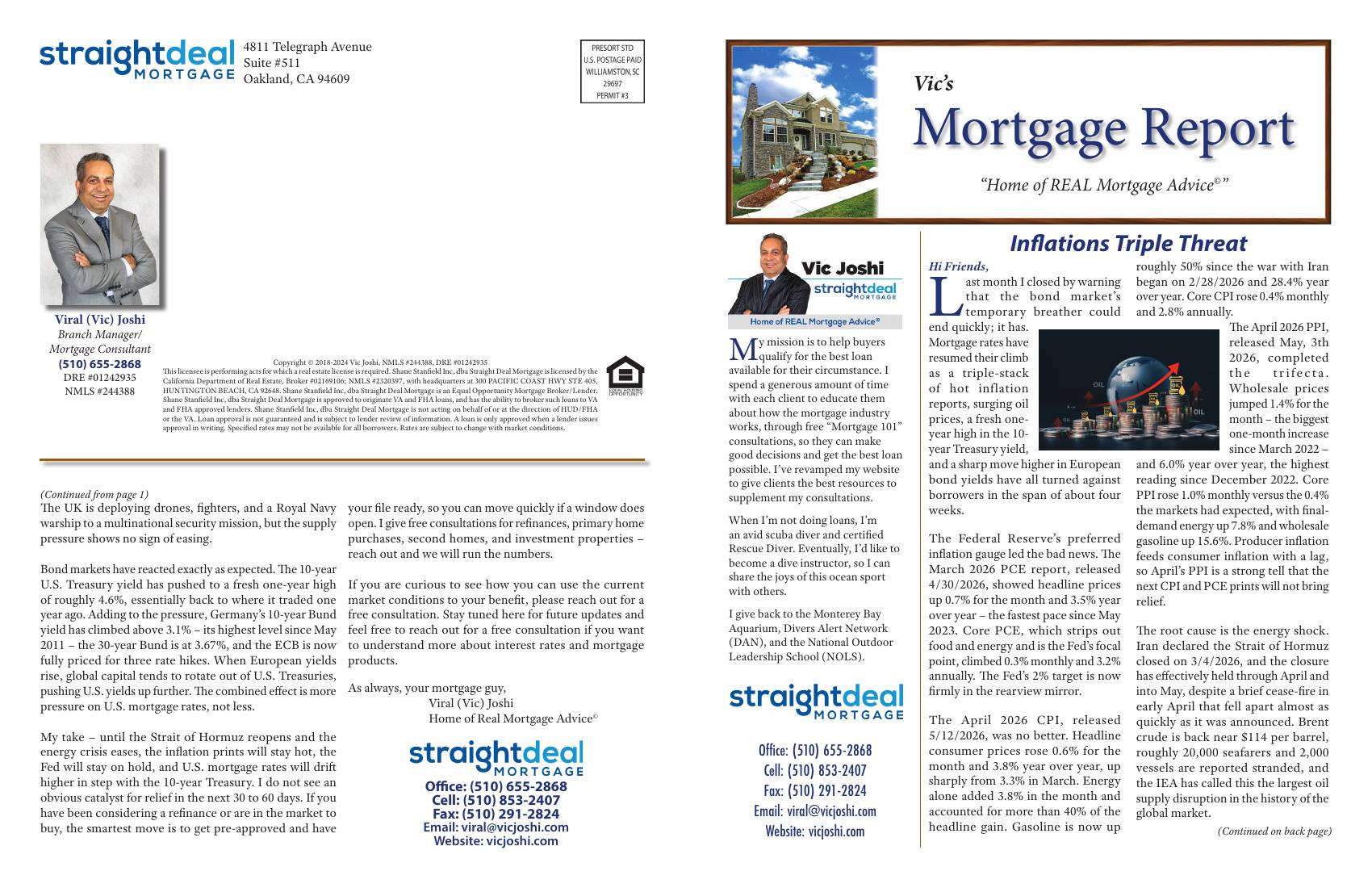
The root cause is the energy shock. Iran declared the Strait of Hormuz closed on 3/4/2026, and the closure has effectively held through April and into May, despite a brief cease-fire in early April that fell apart almost as quickly as it was announced. Brent crude is back near $114 per barrel, roughly 20,000 seafarers and 2,000 vessels are reported stranded, and the IEA has called this the largest oil supply disruption in the history of the global market.
Bond markets have reacted exactly as expected. The 10-year U.S. Treasury yield has pushed to a fresh one-year high of roughly 4.6%, essentially back to where it traded one year ago. Adding to the pressure, Germany’s 10-year Bund yield has climbed above 3.1% – its highest level since May 2011 – the 30-year Bund is at 3.67%, and the ECB is now fully priced for three rate hikes. When European yields rise, global capital tends to rotate out of U.S. Treasuries, pushing U.S. yields up further. The combined effect is more pressure on U.S. mortgage rates, not less.
My take – until the Strait of Hormuz reopens and the energy crisis eases, the inflation prints will stay hot, the Fed will stay on hold, and U.S. mortgage rates will drift higher in step with the 10-year Treasury. I do not see an obvious catalyst for relief in the next 30 to 60 days. If you have been considering a refinance or are in the market to buy, the smartest move is to get pre-approved and have your file ready, so you can move quickly if a window does open. I give free consultations for refinances, primary home purchases, second homes, and investment properties – reach out and we will run the numbers.
If you are curious to see how you can use the current market conditions to your benefit, please reach out for a free consul tation. Stay tuned here for future updates and feel free to reach out for a free consultation if you want to understand more about interest rates and mortgage products.